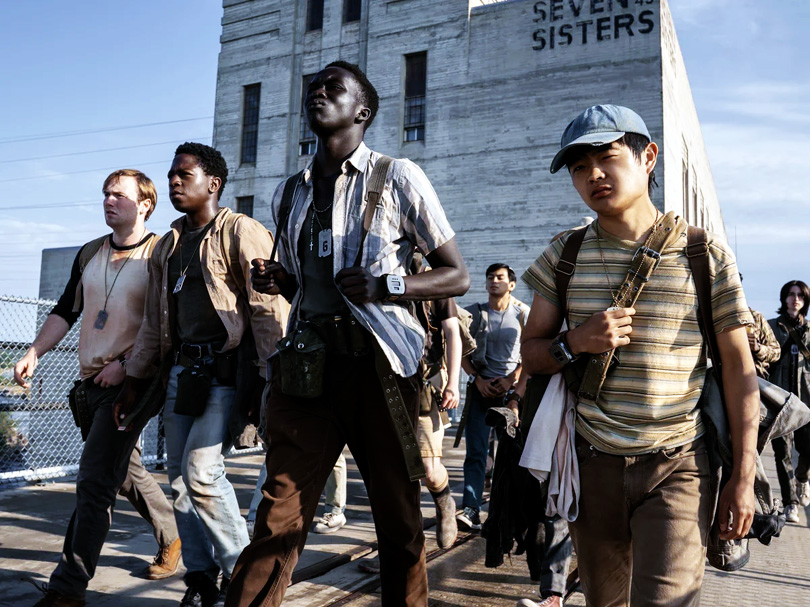
The Long Walk: Marching Nowhere, Hoping Anyway

I just finished watching The Long Walk, and wow, bleak doesn’t even begin to cover it. I love a good “crush my spirit and leave me staring at the wall” film as much as the next emotionally unwell cinephile, but this one? This one is mean. I have so many curse words floating around my brain right now they’re bumping into each other like pinballs.

Some movies telegraph their emotional doom early. This one does it in the first ten minutes. The premise is brutally simple: in an alternate 20th-century America, after some unnamed war and economic collapse, a military regime decides to boost national morale by… forcing 50 teenage boys to walk hundreds of miles until only one survives. The winner gets a big check and one wish granted.

Why? Great question. I have no answers and neither does the film.

You know going in: there is no version of this story that ends in anything resembling satisfaction. It’s teens walking to their deaths while trying to make jokes and friendships to keep from collapsing. It’s tender and cruel at the same time — like someone softly holding your hand while leading you directly into a meat grinder.

And yet, the movie insists this horror show gives society hope. Which brings me to the question that hijacked my brain:

Hope for who? And… how exactly?

The regime claims the Walk inspires patriotism and work ethic—the stuff that famously fixes economic depressions. Forget economic policy, currency stabilization, international trade… real nations are built on sweaty teenagers doing cardio while the government crosses its fingers!

It’s the political equivalent of your landlord raising your rent and then telling you to “hustle harder.” At least I think that’s the equivalent.

Also, I don’t fully understand economics (and this post is exposing that at a dangerous rate), but I’m 99% sure depressions don’t happen because everyone suddenly stopped being gritty enough. It’s less “you didn’t work hard” and more “the system collapsed and now everyone’s talking about how expensive cereal is.”

And patriotism? Listening to teenagers get shot because they slowed down three seconds too long doesn’t exactly make me want to salute the flag. Then again, guns do inspire patriotism in the US. So okay, fine, point retracted.

Here’s where the film’s bleakness really stings:
The boys aren’t stupid. They know exactly what they signed up for. They know most of them will die. They joke, they bond, they cling to each other like people drowning in the same dark ocean. Their hope isn’t naïve. It’s desperate.

They’d rather march toward death for a chance at escape than stand still in a world designed to suffocate them slowly.

And the ending—that final city, cheering for another dead teenager like it’s a sporting event—feels like a punch to the throat. Are they brainwashed? Are they insulated enough to pretend things are fine? Or have they also accepted that hope and blood are just national currency now?

Honestly, it doesn’t matter. Because they clap anyway.

The Walk isn’t just a contest.

It’s the country.

A pointless march with no end, no meaning beyond survival, and the vague promise that maybe if we endure enough pain, humiliation, and loss, someone will reward us at the end. One lucky person gets a wish. Everyone else gets the satisfaction of having “tried.”

It’s not meant to fix anything. It’s meant to distract us long enough to forget the people in charge have no idea what they’re doing but really hope we keep pretending they do.

Fictional military regimes fail for the same reason real ones would: they know obedience, not strategy. Sacrifice, not solutions. Survival, not progress. They can keep you alive but never help you live. So they dangle a prize and tell you suffering is patriotic. That if some of us die, the rest will eventually prosper.

And we march, because what else is there?

Stand still, and something kills you anyway. Move forward, and maybe, just maybe, it won’t be you.…Wait.
Did I just rant for two pages and then suddenly understand the movie? I think I just Long-Walked myself into enlightenment.