I just took a quiz from an Instagram reel. Essentially, if you have done nine of the things below, you are considered old. Now, requiring a 90% batting average essentially means that all the items on the quiz must apply to you. There are no in-betweens. You’re either old or young.
As I lay on the sofa with knee pain that Google AI describes as “IT band syndrome,” I wanted to feel worse about my age. So I went ahead and took the quiz. Raise your hand if …
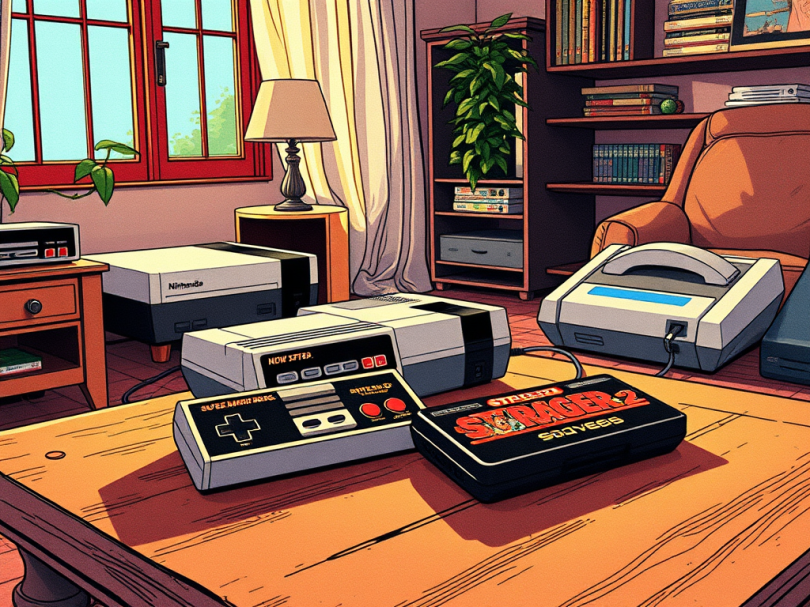
… You remember blowing on a Nintendo cartridge to get it to work.
I played three generations of Nintendo systems during my childhood.
My early memories of the original Nintendo include playing games like Duck Hunt, Super Mario Bros., and the notoriously difficult Teenage Mutant Ninja Turtles game.
Most of my nostalgic experiences come from the Super Nintendo, which I received during a memorable Christmas in 1992 alongside Teenage Mutant Ninja Turtles: Turtles in Time and Street Fighter II Turbo.
In 1996, I got a Nintendo 64 for Christmas, paired with Killer Instinct Gold and Wave Race 64. My dad claimed he bought the console at a Toys R’ Us late Christmas Eve night after two parents were detained by police for fighting over one, making it available for my dad to buy.
For nearly a decade, I would blow into game cartridges to clear dust. I don’t know why Nintendo was so committed to using cartridges despite the rising popularity of CDs with the PlayStation. But their commitment gave us Super Mario Bros. 3, The Legend of Zelda: Link’s Awakening, and GoldenEye 64. We salute you, Nintendo!
… You know what a Sega Genesis is.
As someone who owned three generations of Nintendo systems, I obviously know what the Sega Genesis was. I thought the Super Nintendo was better, but Sega Genesis also had the coolest game ever in Streets of Rage 2.
It’s crazy for me to realize a generation of people might not have ever heard of the Sega Genesis. That I played it doesn’t make me feel old. That Sega didn’t stand the test of time does.
… You know what a VCR player is.
Boy, do I!
I had the distinct pleasure of watching compilations of Michael Jackson’s music videos on VHS, needing a minute to rewind tapes to the beginning, and graduating from VHS to DVDs and Blu-rays.
I laugh seeing how VHS quality has become a nostalgic gimmick, though I don’t remember the video quality being so poor. Maybe I’m more so laughing to hide the tears from knowing my past is now nostalgia for someone else.
My dad would record movies on blank VHS tapes. Being a curious child, I saw a VHS labeled “Midnight Run” and popped it in the VCR. It was indeed a recording of the 1988 film Midnight Run with Robert De Niro. However, a woman’s titties popped up on the screen afterward as I learned my dad would also record adult movies on these tapes.
Second-grade me was in a state of shock. This was also when I learned to be sneaky as I got into the practice of watching and rewinding these tapes whenever I was home alone.
… You’ve ever been to Blockbuster.
My dad and I would visit Blockbuster every Friday to rent movies and games. We actually had two Blockbusters within a 5-minute drive of our apartment in North Atlanta. Compared to my friends, I had better odds of renting desired titles. Na-na na-na boo-boo.
If you don’t know, Blockbuster was a place to rent movies, TV shows, games, and even game consoles. Late fees were incurred if rentals weren’t physically returned within seven days. It was a great place, but Blockbuster’s decline was inevitable once fast delivery and online streaming services became a thing.
… You know what a cassette player is.
Cassette tapes were the equivalent of VHS tapes for music albums. I wasn’t big into listening to portable music until high school, but I remember my mom buying a cassette tape at Eckerds Pharmacy of Snoop Dogg’s “Woof” featuring Mystikal and Fiend. She knew I liked rap music and assumed that meant I liked any and all rap music. I miss her.
… You know what a Scantron is.
Scantrons were small green and white answer sheets used for multiple-choice tests. We had to fill in circles with a no. 2 lead pencil. A machine would then scan these sheets to calculate our test scores.
I assume schools have transitioned to newer testing methods. Because God forbid you needed to erase an answer but had one of those shitty erasers that simply spread the lead rather than cleaned it up.
… You’ve ever used a landline phone.
I used landline phones throughout my career, but the true sign of being old was living in a household that used a landline phone.
I think we had three landline phones in our apartment. The dining room phone was on the wall. So if my mom wanted to sit down and talk, she would have to walk to her bedroom, switch to that phone, and then yell at me to hang up the dining room phone.
Cell phones that weren’t the size of Zack Morris’ car phone were a game-changer. My mom didn’t own a cell phone, and I didn’t get one until 2006, after my dad passed and I adopted his.
I remember my co-worker at Eckerd’s having to call the house phone to discuss a CD cover I was designing for him. Because everyone in Atlanta was an aspiring rapper at that time. He straight up told me that I, a grown-ass man, couldn’t have my mom answer the phone. He was right, but I was broke, so what could I do?
… You’ve ever used a disposable camera.
Quick answer: yes.
Long answer: My early memories of cameras were the Polaroids my mom would use at family gatherings, birthdays, sleepovers, and holidays. It was the size of a brick, and yes, she would lightly shake the pictures to help the image develop quicker.
My family had large binders of photos, and it makes me realize how underdocumented my life is despite owning a smartphone.
On behalf of mom, I did use disposable cameras on school field trips. She would develop the photos at Eckerds. When I think about it, Eckerds Pharmacy handled everything. Whether you needed medicine, photos, food, or supplies, that place had us covered.
… You’ve ever used the Yellow Pages or White Pages.
How else would I get the phone number to both Blockbusters and ask if they had WWF No Mercy?
The Yellow Pages was used to reach out to businesses. The White Pages were used to find personal phone numbers and were of no use to me, a child at the time. Honestly, it was neither practical nor safe for entire communities to have access to strangers’ contact information.
I remember the original Terminator eventually found Sarah Connor thanks to the White Pages but killed a bunch of random Sarah Connors along the way. Terrifying.
… You remember buying four bags of chips for $1.
I guess. I don’t remember buying chips because, as a kid, I had no income. I do remember my mom buying variety packs, which were probably very affordable.
While chips were cool (especially Fritos), I preferred the cereal variety packs instead. There were usually eight tiny boxes of Frosted Flakes, Froot Loops, Apple Jacks, and Corn Pop in a pack. That was such a wonderful time.
When I traveled home last summer, I was shocked at how expensive chips and cereal were. I know my generation constantly says this, but when I was a kid, chip bags had much less air, and there was more cereal in every box.
I’m also convinced cereal tasted better when I was a kid. I don’t care if they had harmful contaminants. A box of Fruity Pebbles tastes like colored cardboard now.
With cereal now costing over $7, I’m reconsidering my decision to return to the US. I’m not concerned about politics, safety, or the job market. I need Cinnamon Toast Crunch to be cheaper.
Shit, I really am getting old.





 Meninity